

Living with Art // Chris Hannah

In our Living with Art series, we step inside the homes of collectors across Perth to see how they live with art and how the works they collect shape the spaces around them.
This interview is with Chris Hannah, an intensive care nurse at Royal Perth Hospital and a long-time lover of Western Australian art, whose home is filled with works by artists including Chris Hopewell, Kevin Robertson, Angela Stewart, Merrick Belyea, Vanessa Russ, Jo Darbyshire, Cathy Blanchflower and Susan Roux.
For Chris, collecting is not about investment or status. It is about instinct, atmosphere and the daily pleasure of living in a visually rich environment. His collection began in 1989 with a Chris Hopewell painting that stopped him in his tracks, and has grown through decades of looking, buying, rearranging and making room for works that simply feel right.
Where does your interest in art stem from?
I’m from a middle-class suburban background, but not a particularly arty family. There weren’t paintings on the wall growing up, so it didn’t really come from there. In my 20s, I hung out with some budding artists, so it was around me, but the breakthrough moment was in 1989. I can date it precisely.
I saw this painting by Chris Hopewell in Fremantle and fell in love with it. At that point, it had never occurred to me that I could buy art. That was a rich person’s game. But I just couldn’t take my eyes off it.
It’s called Squatters. What I saw then, and still see, is something primal and ritualistic. Maybe three dancing figures, maybe head pieces – something strange, but overall positive. I invited Chris over for dinner not long after I bought it and asked him why it was called Squatters. He told me it referred to his New York days, when he was living in squats on the Lower East Side. A squat across the road had burnt to the ground, killing three women. So what I was seeing as three dancing figures was actually three women burning to death.
That stayed with me, because it speaks to one of my core beliefs about art: I will see what I see, independent of the artist’s intent. I couldn’t live with three women burning to death, so I’m sticking with my dancers. It remains probably my favourite piece.
How did you come to Art Collective WA?
There was a period in the 1990s when my future wife and I went on a bit of an art adventure, buying things for our little house. Then life changed and, for a long time, I didn’t really buy art. About two and a half years ago I moved into this house, which gave me more walls and new opportunities. I went online to see what was out there and discovered that almost every gallery I used to go to had gone. That’s part of why Art Collective WA exists.
The Collective’s brief fits my aesthetics. I’m fairly broad. I can respond to rather odd abstract works, portraits, landscapes – I don’t necessarily gravitate towards one genre. But I immediately know. I make up my mind within three seconds.
"I also learned pretty quickly that buying art online can be difficult. There isn’t always the same quality control. With the Collective, the artists are accomplished and the works are strong, so there’s a level of trust there..."

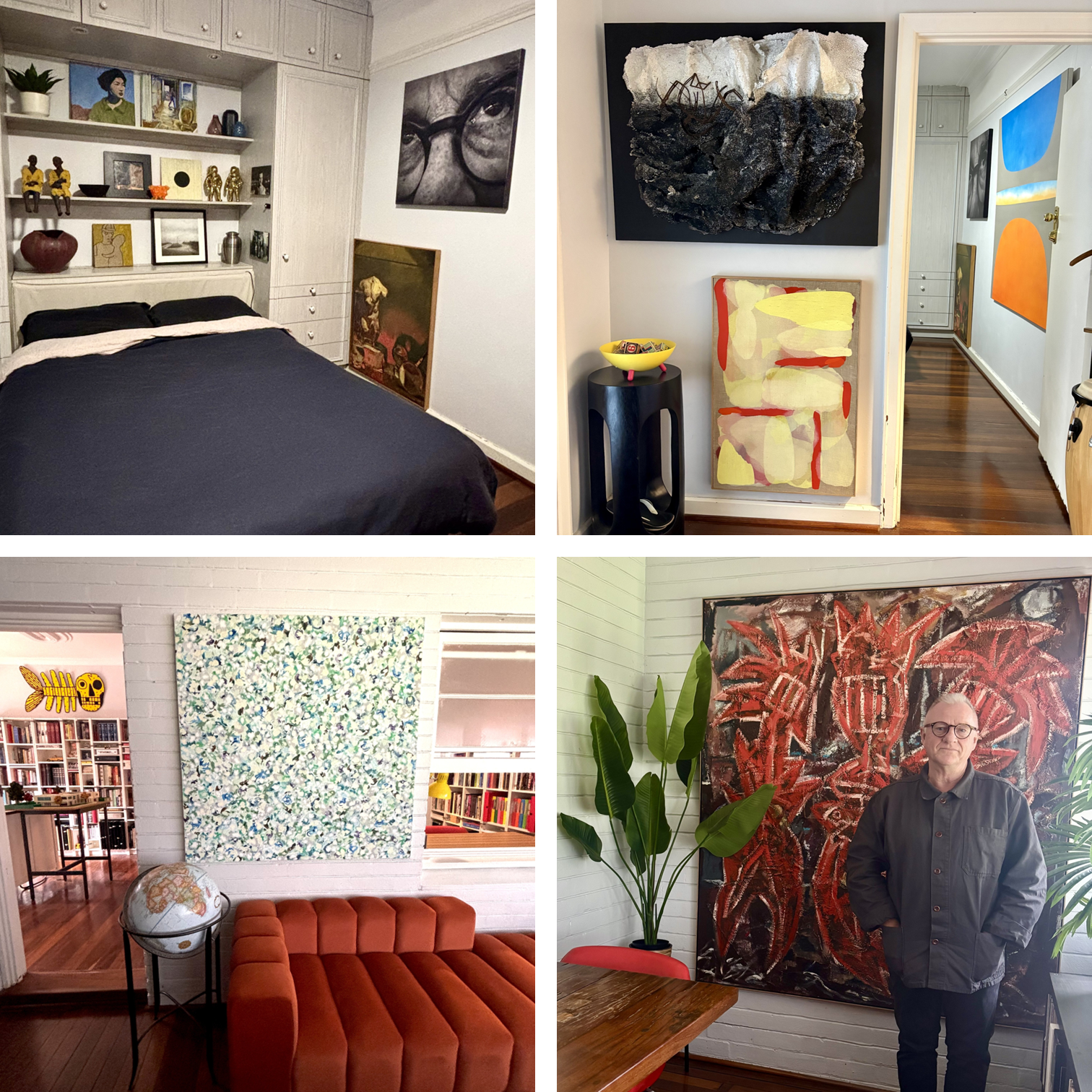
Artworks clockwise from top left (grid): Kevin Robertson, Susan Roux, Jo Darbyshire, Giles Hohnen, Cathy Blanchflower, Chris Hopewell.
What does living with art add to your home?
You’ve got to live somewhere, so why not live in a vibrant, visually rich environment? When I was young, it was posters and that kind of thing, but I increasingly gravitated towards unique works. That’s why I’m fairly equivocal about art photography. I have one piece, but generally I like the uniqueness of painting.
I spend a huge amount of time arranging things. I’ll see something, either in the flesh or online, and if it appeals to me, I’ll buy it assuming it will go somewhere. But it’s only when I get it home that I realise whether it works. Sometimes it just doesn’t, for reasons I can’t explain. It has to work on an aesthetic and emotional level. It can’t just fill a spot.
If it doesn’t work, there go the next two days, because I’ll have to rearrange everything to accommodate it. And I love that process. I pride myself on having a good eye and being a good arranger.
Could you tell me about some of your favourite works from Art Collective WA?
I have four works by Kevin Robertson and had long admired his portraits, so early last year I asked whether he would consider painting mine. I was surprised when he said he’d never been asked.
Because light is so important in his work, I thought he might be interested in painting me here, at home. He came over, liked the idea, and the portrait became me sitting at my dining table. Every Wednesday at 11am, he would arrive for a two-hour session. There were 12 sessions in total.
It was a magical experience – seeing an artist create something from nothing, week by week. At first we talked, but by about week three I started yabbering and he basically said, “Shut up, I’m at work.” From then on, it was music. I had no way of knowing whether I’d like the finished portrait, but I love it.
Are there other works with stories that have stayed with you?
There’s a large work by Angela Stewart called The Cellist. I knew of her work and had seen this piece appear online, but it intrigued me because it was painted in 1992 and had only recently come up for sale. I went in to see it and loved it, but couldn’t afford it at the time. The Collective let me secure it with a deposit and pay it off over time.
When it was delivered, I was told the backstory. The central figure is a cellist who was very important to her and she couldn’t part with the work. It took her more than 30 years to let it go.
I felt almost guilty, like I had stolen something. But I also love living with it. There is so much going on in that painting. It feels emotionally charged.

Artwork: Angela Stewart
What is your approach to collecting?
I’m a nurse on wages, dipping my toes into a world that is closely associated with great wealth. I’m not that person. People might say, “You could sell it,” but that’s not on my agenda at any level. My agenda is that I want to live with this stuff day to day.
I make decisions very quickly. With rare exceptions, I know almost instantly whether I like something. I’m aware intellectually of reputation, but it doesn’t really matter to me.
Because I live in a rental, there are practical constraints and of course some housing uncertainty in the background. I can’t just do whatever I want, but I’m ingenious. I use rails in some rooms and existing hooks where I can. Just when I think the house is full, I rearrange. I see it as an opportunity – to make the most of this place and just enjoy it while I can.
What advice would you give someone starting to collect art?
I’m not sure I can help, because to me it’s so personal. Everyone’s circumstances and budgets are different. But I would say: spend as much as you can, don’t give any thought to resale, and buy it because you love it.
"Don’t overthink meaning. Go on the immediate impact. That’s my approach. I don’t buy art as an investment. I buy it because I want to live with it..."
Visit us in the gallery or browse our Stockroom online to discover a curated selection of contemporary works by our artist members.
Words and photography by Rosamund Brennan.