

Inside the Studio // Paul Uhlmann on Trevor Vickers' Recent Untitled Paintings


Things Were Like That Then
Not long into the evening, deep in conversation with Trevor Vickers, the room becomes crowded with recollections of the many artists he has known – figures who form the fabric of his circle and who collectively helped shape the foundations of how we think about contemporary art in Australia. As a fifteen year old in the late 1950s, Vickers made the trek across the Nullarbor to study telecommunications in Melbourne. His study allowance eventually enabled him to rent his own flat, and in the evenings he immersed himself in reading and painting. It was not long before this art divergence was organically transformed into a stellar lifelong career.
His curiosity about art was ignited through close encounters with works such as the Rembrandts held in the NGV collection, which in the early 1960s was still housed within the State Library. He refers to such institutions as “dictionaries of brushstrokes,” and a lifetime of careful looking has contributed to an internalised understanding of the language of painting and its seemingly infinite variations, meanings and hues.
His flat in the early 1960s Melbourne soon became an informal after hours art school of sorts, where young artists, eager to debate the latest developments, argued long into the night. One of his closest friends at this time was Mel Ramsden, who would later become a foundational member of the internationally regarded conceptual artist group Art & Language. The group’s central insight was that art operates through ideas as much as images – that the conceptual framework of a work is as significant as any object produced, and that the representational world and the assumptions underpinning visual appearance needed to be rigorously questioned. Within such a radical framework a conversation or an insight could become an artwork.
Some of the central concerns circulating internationally at this time involved a reaction against the expressive nature of the mark, as seen in Abstract Expressionism. This new tendency sought to move away from the heroic, signature gesture of the artist and toward works that left no trace of the subject who made them, appealing instead directly to the mind. If such a bridge can be made, then the work itself, as a primary object, interacts unimpeded with the mind of another. The viewer completes the work through their presence and interpretation, giving it meaning and resonance.
It is fascinating to listen as Trevor talks into the evening about these formative years. These were protean moments when artists and dealers were actively involved in creating a world of interpretation. It sounds like a heady mix, as the rules of engagement were being actively formed through experimentation, ambition and discovery. There is a vast difference between digesting a resolved art theory – something one might do on a sleepy afternoon in a library – and actually living through and developing the concepts themselves.
Close friends dropping in and out of his flat or later living and working alongside him in his Drummond Street studios in Carlton, included Mike Brown, Paul Partos, Robert Hunter, and Dale Hickey. He received active support from Sweeney Reed and his gallery, Strines. Reed – whose mother and father were Joy Hester and Albert Tucker, artists whose work is often used to demonstrate the harsh realities of life in the 1930s and 1940s, and whose portraits captured the psychological tensions of a tortured period. He was also the adopted son of Sunday and John Reed, who had provided support and encouragement to a whole generation of Australian artists, particularly the Angry Penguins, including Sidney Nolan and the Boyds.
The work emerging in Drummond Street was made possible through the tensions that arise when one works against the immediate past – leveraging against the mark of the Tuckers and so on – but also against the very system of established aesthetics. These tensions were real, as demonstrated by an offended patron at the opening night of Vickers’ second solo show, when an older woman, after viewing his work, went home and returned to throw a bucket of paint over one of the pieces. This scene was observed from a detached distance by Vickers, who was enjoying a beer with his new friend Paul Partos in a pub across the road.
It was a deliberate statement, then, to gather up these young artists and curate them into the exhibition The Field, which was the inaugural exhibition held at the National Gallery of Victoria for their new and now much loved building in Swanston St. The show was curated by a young and enthusiastic John Stringer, fresh from a trip to New York and encounters with Andy Warhol, decided to clad the walls in silver foil. A reconstruction of the exhibition was staged in 2018, and video footage of these curatorial decisions reveals just how radical the installation was: the works appear to hover off the walls, their starkness and originality made even more apparent by the reflective surfaces.
What interests me in contemplating Vickers’ work is the way it was shaped by various tendencies from abroad, such as the hard edge painting emerging on the east coast of America, and yet he has travelled his own course from the beginning. Australia’s isolation from direct artistic traditions and fluent, first hand influence meant that artists received news of developments through magazines and poor reproductions. In a sense, this informed them whilst at the same time freed them to chart their own paths. The dialogue sparked their own fires, leading to original developments. For example, for one of his works in The Field, Vickers clamped separate panels together with flat colour – an invention entirely his own (as noted by Alex Selenitsch in the monograph on Vickers).
Current work for his exhibition Recent Untitled Paintings (2026) at Art Collective retains the spark of those formative years, yet it is also shaped by the depth of experience, thinking, contemplation and making that has accumulated through a lifetime of looking and engaging with the act of painting. After those early days, Vickers spent nearly twenty years in England, during which he was influenced by the vital traditional culture he encountered on repeated trips to Catalonia. Among the most significant experiences were his encounters with Romanesque frescoes. These frescoes employ flat chromatic colour and sequentially coloured sections that immerse the viewer in a way not unlike contemporary installation art. The proportions and visual language of this tradition occasionally find their way into Vickers’ work.
However, it would be a mistake to trace simple or direct lines of influence in any of his paintings, for there is always a process of reduction and perhaps even an erasure of history at play. Standing before a work by Vickers, it is the experience itself that must be taken into account: how the painting alters and sharpens our perception of reality. As the artist – now a living Western Australian treasure – notes, his work is not abstract; it is reality itself.
Paul Uhlmann, May 2026
Charles Nodrum Gallery. (n.d.). Mike Brown. https://www.charlesnodrumgallery.com.au/artists/mike-brown/
Department of Local Government, Sport and Cultural Industries. (2024). State cultural treasures 2024: Trevor Vickers.
https://www.cits.wa.gov.au/department/publications/publication/state-cultural-treasures-2024
Gaynor, A., Johnston, F., Selenitsch, A., & Willingham, A. (2016). Trevor Vickers: Untitled painting. Art Collective WA.
Heide Museum of Modern Art. (2018). Sweeney Reed and Strines Gallery. https://www.heide.com.au/exhibitions/sweeney-reed-and-strines-gallery/
National Gallery of Victoria. (n.d.). The Field. https://www.ngv.vic.gov.au/exhibition/the-field/
National Gallery of Victoria. (n.d.). The Field revisited [Video]. https://www.ngv.vic.gov.au/multimedia/the-field-revisited/
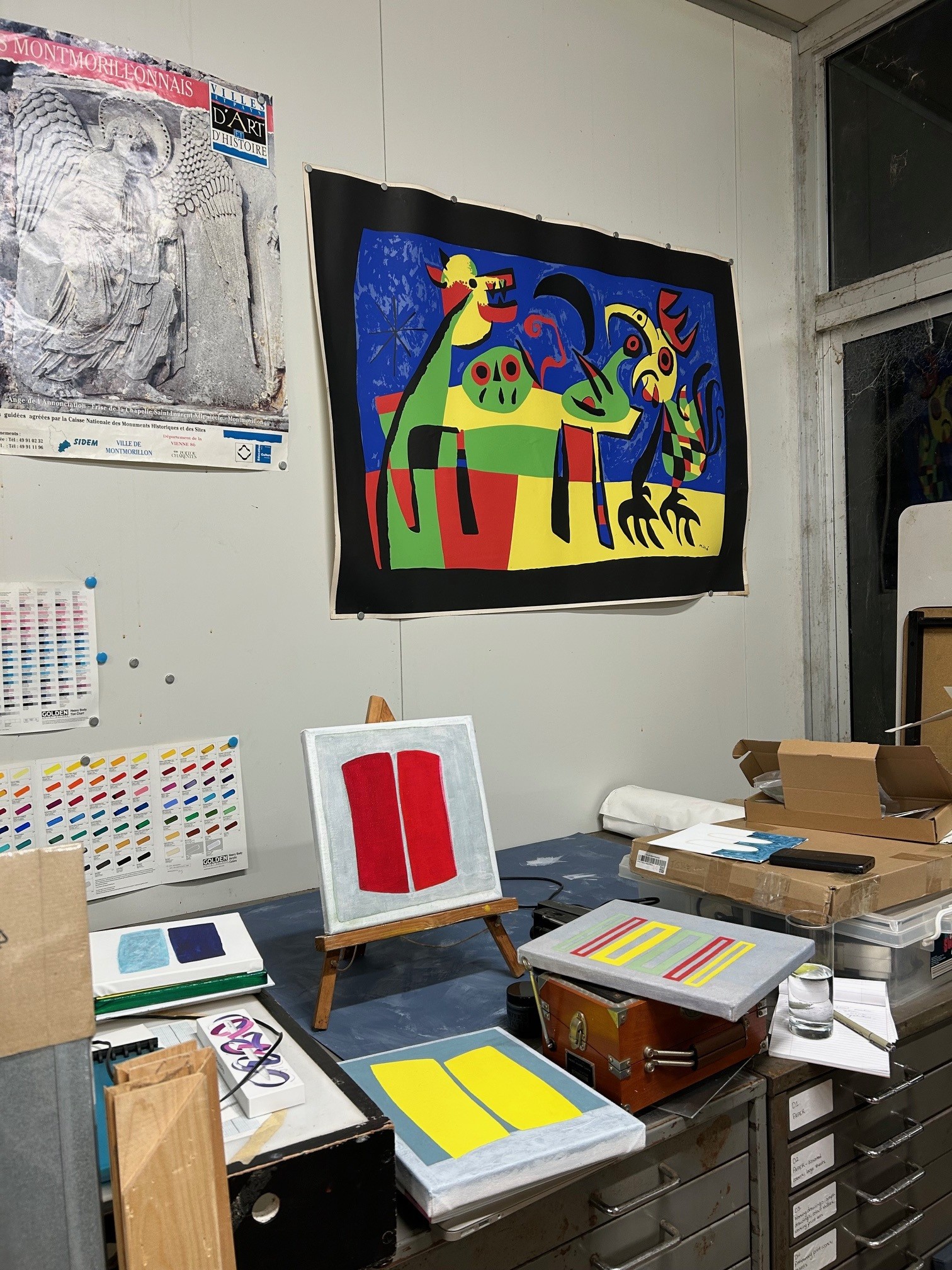
Trevor Vickers Studio. Photo by Paul Uhlmann.