

Inside the Studio // Paul Uhlmann on Jennifer Cochrane's Prospect


Contemplating Time Within Form
The work of Jennifer Cochrane appears, on first encounter, to be highly geometric and refined. In this sense, it seems to echo the concerns of minimalism, a movement grounded in the reduction of form to its essentials. Artists associated with this genre include Richard Serra, whose titles – such as Weight and Measure – function almost as manifestos for his pared‑back aesthetic.
Across Europe, in cities such as Amsterdam and Basel, one can become bodily immersed in a Serra sculpture. These works are often colossal: vast rising slabs of steel that dwarf anyone who makes a pilgrimage to see them, whether encountered in public spaces or within specially designed environments such as the Guggenheim Museum in Bilbao. Usually black and light‑absorbing, these forms lean against one another like the playthings of giants. They seem to operate as objects that tell us something about the natural world, or about the worlds of thought and architecture. They also appear to defy gravity, perpetually on the verge of collapse yet never completing the action.
Serra’s early work is fundamentally about process. For example, his Gutter Splash: Two Corner Cast (1992), held at De Pont Museum in Tilburg, records the action of throwing molten lead. The residue of this gesture – what occurs through the physics of heat, weight, and impact – becomes the essence of the work, inviting contemplation of cycles of transformation and the ways materials change under dynamic forces. His attraction to verbs as conceptual anchors extends to his piece Verb List (1967–1968), in which principles of action are itemised like a shopping list: “to tear, to cut, to splash.”
Thinking about Serra as a pre‑eminent example of minimal art may offer one way into contemplating the work of Perth artist Jennifer Cochrane. However, I suspect that there are worlds of difference.
One immediate difference is the choice of materials. For some time now, Cochrane has been working with jarrah railway sleepers. When settlers first encountered the jarrah forests along the West Australian coastline, they were awestruck; and, in a manner similar to Serra’s black forms, these towering trees made them feel small and insignificant. This experience aligns with the concept of the sublime—being struck with wonder simply by allowing oneself to be in the presence of nature. Yet perhaps the better response would have been to allow these sights of wonder to remain and flourish. These giants were harvested during early colonial settlement as one of the first viable exports, with many trees logged and transformed into paving blocks and later railway sleepers for railways in Asia and beyond.
Jennifer Cochrane is acutely aware of the history embedded in these sleepers, and the environmental impact of our presence in the landscape underpins her concerns. She feels herself to be complicit in this history, and so many of her works carry “self‑portrait” in their titles. She notes that we are surrounded by these former forests – in the structures of houses and on the floorboards beneath our feet – yet we are often unaware of it.
Importantly, she explains that much of what she does is an internalised process rather than something operating at a conscious level. Through our conversation, however, it becomes clear that she wants to heighten our awareness of the qualities and inherent meanings within jarrah. She also wants to celebrate the quality of time that remains manifested within these logs: the slow time of their growth, and the deeper evolutionary time embodied in these wondrous natural forms.
During a recent studio visit, as we stood before a very large and heavily weathered piece of jarrah, it became apparent that the log remnants also carry the history of years of weight and motion, for this former railway sleeper had lived a long life on the tracks. Its weathered surface is a source of fascination for Cochrane. She sees landscapes within these surfaces, as though this fragment of nature carries within it the blueprint of the macro‑world from which it comes.
She burns the surface of the wood so that a rich, primordial black emerges – something that continues to captivate her. I feel that this blackness is almost Taoist, a reduction to essentials. The void is central to Taoist consciousness: in contemplating emptiness within all things, we glimpse the heart of reality, we glimpse life itself.
She tells me that she tidied her studio for my visit, only to realise how much activity is required to create such simplified forms – how they emerge out of chaos.
She does not want to impose her interpretations on the viewer, and in many ways, when she is in the midst of making, she admits that something else takes over. It is not simply about the ideas that others may project onto the work; it is about the process of making and the work’s own development. There is something intrinsic within the act of making that moves beyond words and analytic interpretation. Often one does not fully know oneself; the work instructs the maker, and understanding arrives later. What remains “unsaid” becomes more important. The materials themselves have a great deal to say in determining how the work finds its final form.
When I ask what she, as an artist, would like the viewer to take from the work—what kind of reaction she hopes for – she answers, “My aim is perhaps a low bar… my aim is to make the viewer pause.” In an age of distraction, when so many spend hours staring into blue screens, I think this is, conversely, the highest possible expectation we can have.
Paul Uhlmann, May 2026
De Pont Museum. (n.d.). Richard Serra: Gutter Splash / Two Corner Cast. https://www.depont.nl/en/collection/artists/richard-serra/gutter-splash-two-corner-cast
Matthew Marks Gallery. (1996). Richard Serra: The weight and measure etchings and Ike and Tina: A wall drawing. https://matthewmarks.com/exhibitions/richard-serra-the-weight-and-measure-etchings-and-ike-and-tina-a-wall-drawing-03-1996
Sculpture at Scenic World. (2017, April 6). Jennifer Cochrane – Sculpture at Scenic World 2017 [Video]. YouTube. https://www.youtube.com/watch?v=yo-C2Ez6fxo
Serra, R. (1967–1968). Verb list. The Evergreen State College. https://sites.evergreen.edu/expphoto/wp-content/uploads/sites/293/2018/08/serra_verbs.pdf
Tate. (n.d.). The sublime. https://www.tate.org.uk/art/research-publications/the-sublime
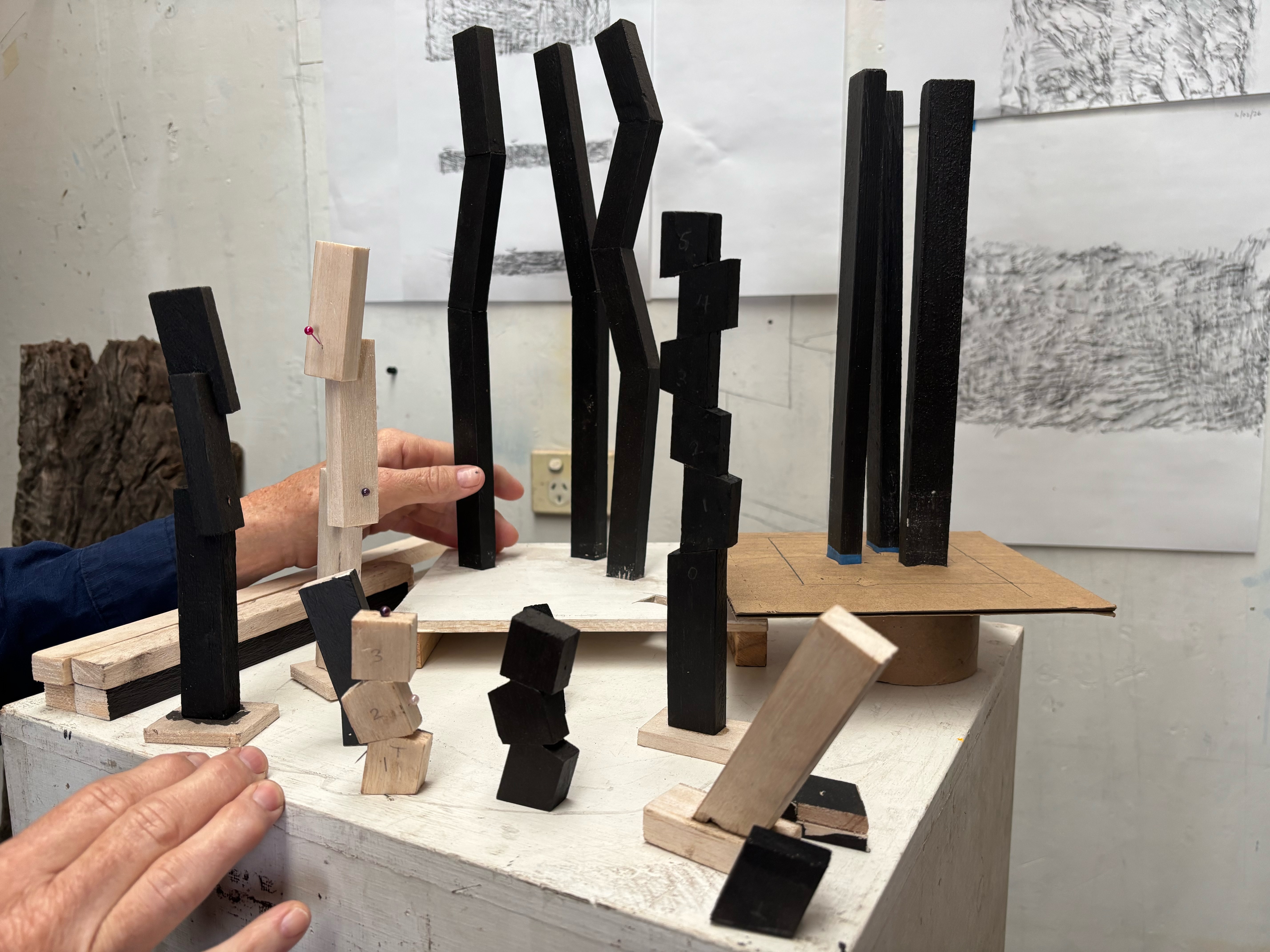
Jennifer Cochrane's maquettes in her studio. Photo courtesy of the artist.