

Inside the Studio // Paul Uhlmann on George Haynes’ Skyland


Distillation of Multitudes: Australian Painter George Haynes Still Expands the Field of Painting
George Haynes, perhaps Australia’s most venerable painter, was deep in concentration when I arrived at his home studio late one Tuesday afternoon in early March. I was a privileged guest there to interview him with the aim of gaining insight into his creative process. The painting before him – the work that had absorbed his attention for the past two weeks – bore no resemblance to anything for which he is known. At first glance it appeared to be an abstract composition of triangles and grids of colour, hovering between form and formlessness, between an atmospheric landscape and pure abstraction. However, it occupied a space in‑between – something felt and sensed through the intuitive logic of painting, where colour as sensation becomes the focus and the field of inquiry. As I was to learn, its unpredictability was entirely aligned with his way of working: many have spoken of how Geroge Haynes follows an inner voice, untroubled by the art market or the lure of a signature style. His painting mirrors life itself – elusive, responsive, always changing, and always of the moment.
After George had laid down his brushes for the day, we sat round a table and drank tea, wine, and gin and tonic. We were sitting inside his expansive studio that he shares with his partner, fellow Art Collective WA artist member Jane Martin – the space filled with radiating golden light. They bought the place about 22 years ago and proceeded to take apart the outside shed which formerly had been a site for cleaning and preparing potatoes for Spearwood market gardens. They opened it right up, installed a steel-framed bay window to the northern end and a series of windows overhead. Luminous light filled their studios and windows opened onto the garden so that bamboo shoots were never far from view. Every artist craves contemplative space and time and I could sense the collective hours of contemplation held within these rooms.
Responding to my questions about his methodology, he sketched a sense of his formative years in the late 1950s and early 1960s at Chelsea School of Art in London. Drawing, he explained, was considered an essential foundation: students worked directly from life, developing a structural sense of form and line through disciplined observation. That discipline permeates the life-long work of George Haynes. He shows me a charcoal drawing which is a precise rendering of an abandoned Chevy collecting rust in a field on a farm. “You see,” he says, “here I have drawn the thistles through the absence of form, by creating negative space”. The volumes of form are implied by their absence.
‘Chelsea’, during that exhilarating post‑war period, was a place where ideas and the act of making were absorbed almost by osmosis – but also honed through continual, disciplined application. Haynes recalls how he became absorbed in the simple but profound exercise of placing a dot of colour on a canvas, then another dot nearby, and attending closely to the difference. Through this, he developed a heightened sensitivity to the potential for vibration through colour – the way hues can resonate, clash, or harmonise, like musical notes. These sonic experiments in harmony and dissonance continue to animate his painting today.
What becomes clear is that George Haynes is constantly seeking something new of painting – always testing the limits of what can be seen, felt, or understood through the act of looking. At times this will involve contradictions and the clash of opposites, to arrive at what he famously declared to be “charged chromatic collisions”.[1] His painting is, in the main, a lifelong inquiry into the possibilities of perception.
For the current show, Skyland, Haynes is drawing from intense memories of camping between two salt lakes. Here he is absorbed by the play of light and the highly reflective qualities of the atmosphere. The challenge for Haynes is to tackle the way in which the shift of light changes the sky and surrounds. To paint the expanse of Western Australia is never a simple prospect and this is where his experimentation with colour and harmonies materialises and is given form.
Our conversation turns to the painting that he was working on when I interrupted him. To my mind it appeared to be influenced through the grid structure and application of colour by the Bauhas artist Paul Klee. Could his work a guiding influence? “Yes … and no … but I am interested in so many artists …” Curious about this evasion I wondered if perhaps Bonnard was of influence with his emphasis on the materiality of colour and the subject of everyday life, as this appears to be the genus loci of Haynes. “Vulliard is someone I admire much more – I have his complete catalogue raisonné in my library”. Jean‑Édouard Vuillard, the idiosyncratic French postimpressionist painter created flattened compressed asymmetrical spaces of pure glowing colour; at times the figures emerge and disappear from patterned backgrounds. These are painterly worlds of pure delight and Haynes’s reference to them generates a dynamic that can only be understood through deep contemplation of the act of painting itself as a site which questions reality not as it is seen, but as it is experienced and embodied.
As I spent more time with George it occurred to me that he was an artist who could perhaps best be described through the fragment of poetry by Walt Whitman, for Haynes is not an artist who has one signature style or voice, rather he contains multitudes.
Do I contradict myself?
Very well then I contradict myself,
(I am large, I contain multitudes.)
From Song of Myself, Walt Whitman[2]
Indeed, the collection of works hung in his studio contained multitudes of being. As I was leaving his studio, the sky darkened with black, red-tailed cockatoos and their cries filled the studio and passed through our bodies, animating a sense of place even further.
Paul Uhlmann, March 2026
[1] Quin, S. (2023). From Chelsea to Perth: The Early Work of George Haynes, 1962–1972. In George Haynes: In Search of Painting (p.32). Art Collective WA.
[2] Whitman, W. (n.d.). Song of myself (51). Poets.org. https://poets.org/poem/song-myself-51
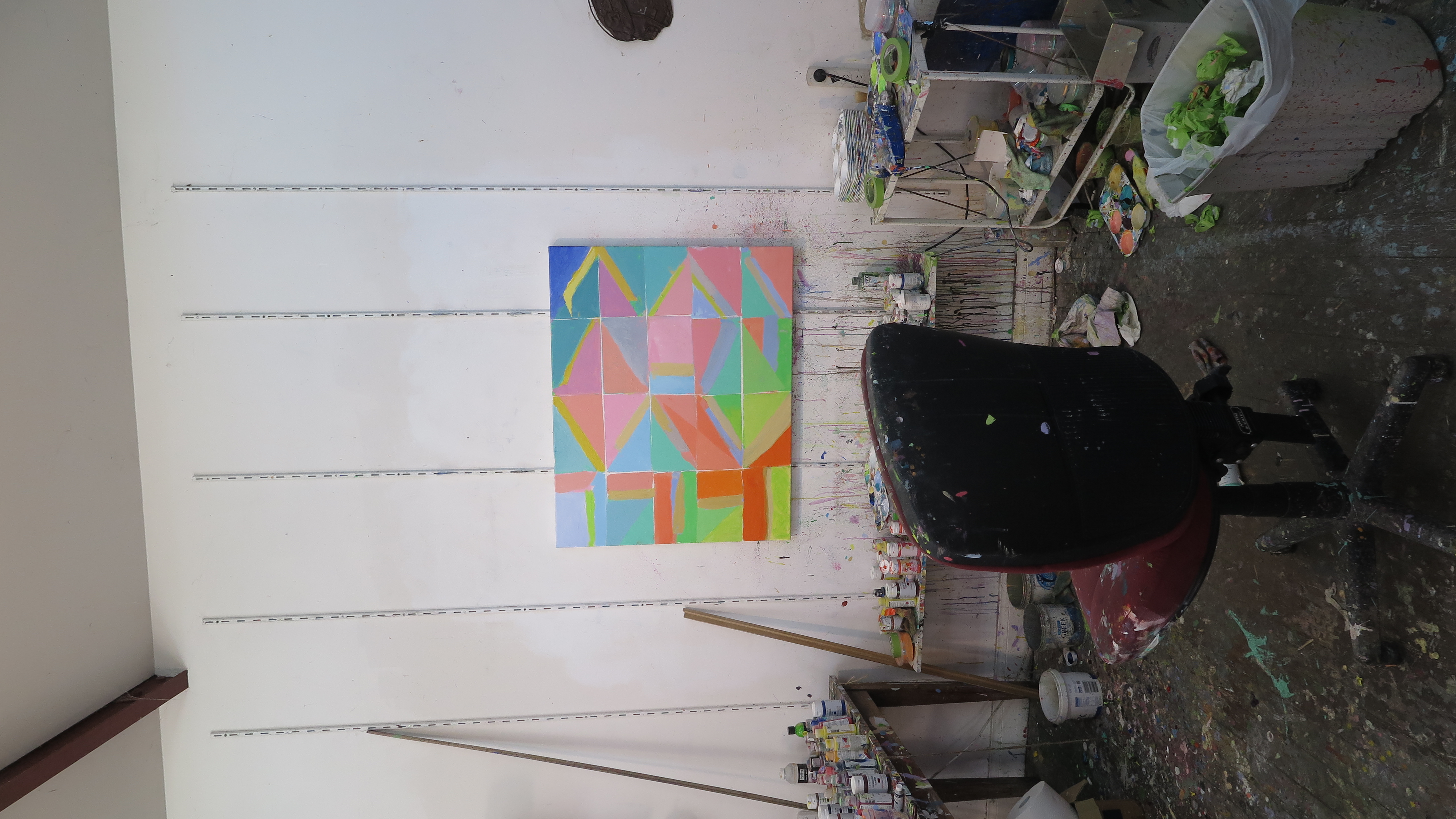
George Haynes Studio. Photo by Paul Uhlmann.